
Free interactive practice
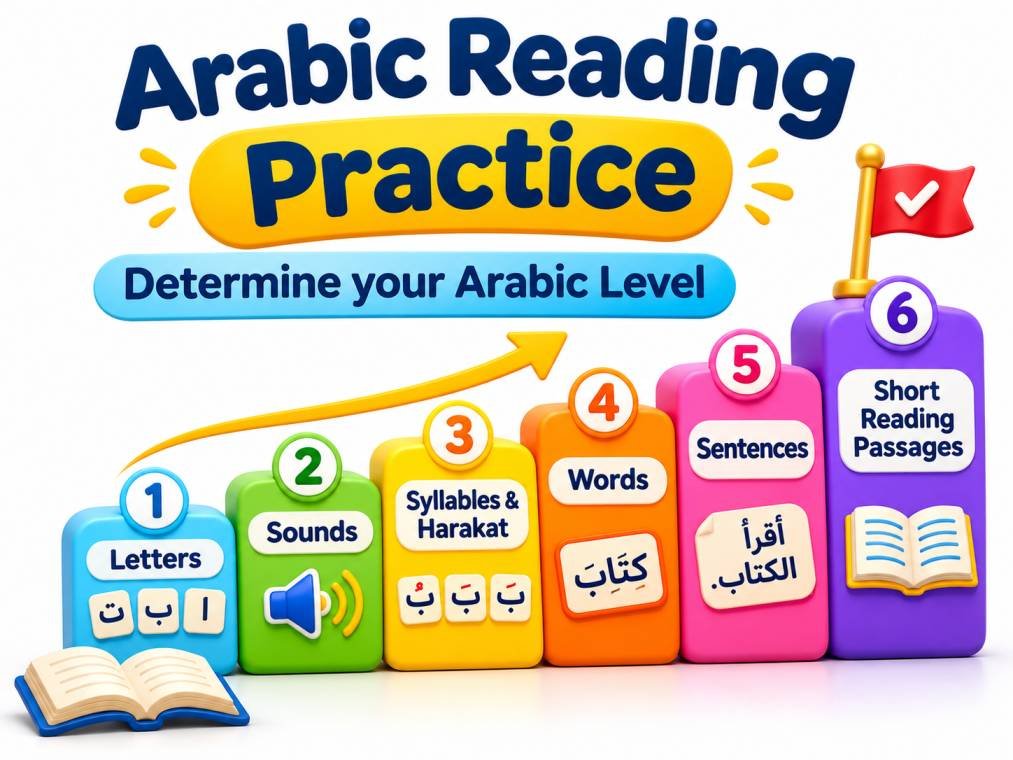
Arabic Reading Practice: Free Exercises from Letters to Short Passages
Real reading begins when you stop guessing and start sounding out the words.
- 6 levels
- No login
- Instant feedback
Can you read these three sounds? بَ بِ بُ
If you knew them immediately, brilliant. If you had to pause, that is exactly what this page is for. You do not need another long explanation before you begin. You need a little practice, a clear answer, and the chance to try again.
This free Arabic reading practice page is designed for beginners, adults restarting Arabic, and parents practising with children. Choose your level below, read the Arabic before revealing the answer, and repeat an exercise whenever you need. There is no race.
Choose Your Practice Level
Teacher audio recordings are being added. Buttons marked “Audio coming soon” will play once they are ready; every read-and-reveal exercise works now.
New to the alphabet? Start with our step-by-step Arabic alphabet guide before trying the exercises.
Level 1 — Can You Recognize the Arabic Letters?
Goal: Recognize a letter by its shape and dots, even when it appears inside a word.
Arabic has 28 basic letters. Some look almost identical until you notice the dots. Rather than trying to memorize all 28 at once, begin with a small group and test what you remember.
Practice A: Which letter is ت (taa)?
Choose one:
Practice B: Which letter has one dot below?
Choose one:
Practice C: Find the same letter in different positions.
Look at: ب بـ ـبـ ـب
Tap each shape to hear the same letter. Then choose which shape represents ب in the middle of a connected word.
A helpful detail: ا، د، ذ، ر، ز، و do not join to the letter after them. So not every letter can appear in all four connected shapes.
Not sure why letters change shape? Take a quick look at our Arabic letters at the beginning, middle, and end guide, then come back to this quiz.
Checkpoint: Can you recognize the letters without looking at their names? If not, try a fresh set of five.
Say each letter’s name first, then tap to check.
Level 2 — Can You Hear and Say the Sounds?
Goal: Connect the written letter to the sound it actually makes.
Recognizing ح is one thing. Pronouncing it is another. Start by listening to your teacher, then say the sound yourself. Your mouth and ears need practice together.
Watch and practice
Arabic Letter Pronunciation
Play the short teacher video. Pause after each sound. Listen → repeat → listen again.
Teacher video coming soon
Where the sounds come from
Sound challenge A
Play a recording of ح. Which letter did you hear?
Sound challenge B
Play a recording of ق. Which letter did you hear?
Sound challenge C
Compare س and ص. Can you hear the difference before you reveal the letters?
Sound 1 was س and sound 2 was ص. ص is the fuller, heavier sound.
Give yourself time. Certain Arabic sounds may be unfamiliar, especially for English-speaking beginners. A quiz can check your recognition, but accurate mouth and throat articulation may need feedback from a qualified teacher.
Want a closer look at difficult sounds? Visit our guide to pronouncing Arabic letters at home.
Level 3 — Can You Blend Arabic Sounds?
Goal: Read small sound units without guessing the vowel.
The three short vowel marks (Harakat) make a big difference. Fatha (◌َ) gives a short a sound, Kasra (◌ِ) gives a short i sound, and Damma (◌ُ) gives a short u sound.
Try these first:
Now switch the letter:
Your turn — which sound do you see?
Question 1
بُ
Question 2
مِ
Question 3
سَ
Next challenge
Short Sound or Long Sound?
Compare بَ (ba) with بَا (bā), بِ (bi) with بِي (bī), and بُ (bu) with بُو (bū). Play both recordings, decide which lasts longer, and then read the pair yourself.
Pair 1 · play both, then choose the longer sound
Pair 2 · play both, then choose the longer sound
Pair 3 · play both, then choose the longer sound
Optional, for later
Once short and long vowels feel easier, unlock optional practice with Sukoon (◌ْ), Shaddah (◌ّ), and Tanween. These are later reading skills; you do not need to learn them all today.
- ◌ْSukoon
- ◌ّShaddah
- ◌ًTanween
- Practice sets coming soon
Checkpoint: Can you read a new consonant + vowel combination without English transliteration?
Level 4 — Can You Read Real Arabic Words?
Goal: Blend familiar sounds into a complete word.
Now the real reading begins. Look at the word before pressing Play. Read it slowly. Then listen to the correct reading and try again.
- 1. Look
- 2. Read slowly
- 3. Listen
- 4. Try again
Easy
Read the Short Vowels
kataba · “he wrote”
jalasa · “he sat”
rasama · “he drew”
Medium
Notice the Long Vowels
bāb · “door”
long ā
kitāb · “book”
long ā
nūr · “light”
long ū
These practice the long ā, ī, and ū sounds.
Challenge
Read Before You Hear
Three new vowelized words. Read each one, choose its reading, and only then see the English. Replay any word, then ask for a new set.
A good rule: accuracy first, speed later. Reading one word correctly is better than rushing through five and guessing.
Level 5 — Can You Read Simple Arabic Sentences?
Goal: Read the words together without losing the meaning.
You may know every word but still pause between them. That is normal. Read each word, then try the whole sentence smoothly.
Sentence 1
كَتَبَ سَامِي.
Sami wrote.
Sentence 2
جَلَسَ سَامِي.
Sami sat.
Sentence 3 Challenge
قَرَأَ سَامِي كِتَابًا.
Sami read a book. This sentence introduces some more advanced marks; use the audio if you are ready for a challenge.
Quick meaning check
Which sentence says “Sami sat”?
Try each sentence twice. The first time, focus on the letters and vowels. The second time, see whether you can connect the words more naturally.
Level 6 — Can You Read and Understand a Short Arabic Passage?
Goal: Read a small story, understand the basic idea, and answer a few questions.
This level is for learners who can already read simple words and sentences. If it feels difficult, return to Level 4 or 5. You do not have to finish everything in one visit.
Read the story
ذَهَبَ سَامِي إِلَى الْمَكْتَبَةِ. فَتَحَ كِتَابًا صَغِيرًا. قَرَأَ صَفْحَةً، ثُمَّ كَتَبَ ثَلَاثَ كَلِمَاتٍ.
Read it once without help. Then play the teacher's recording and read with the audio. Only after that, reveal the English meaning.
-
1Read once without help
Take your time. Point to each word as you read.
-
2Read with the audio
The gold pointer moves word by word so you can keep pace.
-
3Reveal the meaning
Finish step 1 first.
Sami went to the library. He opened a small book. He read a page, then wrote three words.
Check Your Understanding
1. Where did Sami go?
2. What did he open?
3. How many words did he write?
Optional challenge: Hide the English translation and read the same passage again. Can you answer without relying on a word-by-word translation?
This is Arabic reading comprehension practice, not simply a pronunciation test. Both skills matter, and they grow at different speeds.
How Should You Practice Arabic Reading Every Day?
Five focused minutes are a useful starting routine: spend one minute reviewing previous mistakes, two minutes on a new exercise, one minute listening and repeating, and one minute reading again without assistance.
- Review previous mistakes1 min
- Try a new exercise2 min
- Listen and repeat1 min
- Read again without assistance1 min
For children, keep the activity light and playful. For adults, practice at your own pace and return when you have a quiet moment. If you're restarting after years away from Arabic, our guide to learning to read Arabic as an adult may help you build a realistic routine.
You do not have to reach Level 6 today. Choose the next small skill, repeat it, and enjoy being able to read a little more than yesterday.
Frequently Asked Questions
Can I practise Arabic reading without learning Arabic grammar?
Yes. Start with letters, sounds, vowels, and simple words. Grammar becomes more useful as your sentences and reading comprehension become more complex.
Should I read Arabic with or without vowel marks?
For beginners, fully vowelized text helps you connect letters with their sounds. Gradually introduce less-vowelized material when your reading is accurate enough.
Can this page help me read the Quran?
It builds foundational Arabic decoding skills that are useful before Quran reading. Quran recitation also requires correct pronunciation and, as you progress, Tajweed instruction; these practice quizzes are not a substitute for listening to a qualified teacher.
Is watching a pronunciation video enough?
A video can demonstrate a sound, but you also need to pronounce it, compare it with a correct model, and receive feedback when you are unsure.
What if I make the same mistake repeatedly?
That mistake shows you what to practise next. Replay the audio, slow down, and retry just a few examples. If the error continues, ask a teacher to listen.
Need Personal Help With Your Arabic Reading?
Sometimes you can recognize the rule but still struggle to pronounce a sound or blend a word. That is where personal guidance helps. Quran Home's Arabic Reading Foundation course offers structured practice with a teacher and support that moves at your pace.
Explore the Arabic Reading Foundation CourseAbout the HICR Reading Approach
HICR (How I Can Read?) — adapted practice companion
This Arabic reading practice resource was developed with reference to HICR (How I Can Read?), Quran Home's Arabic reading program by Sheikh Mustafa, CEO of Quran Home. The public exercises on this page are an adapted practice companion, not a reproduction of the full 12-unit curriculum.

Sheikh Mustafa — CEO of Quran Home
Dedicated to equipping educators with modern pedagogical techniques, curriculum development, and effective cross-cultural communication strategies to enhance the learning experience for non-Arabic speakers.