
Pronouncing Arabic Letters at Home: A Simple Practice Guide for Beginners
Have you ever played an Arabic pronunciation video, repeated a letter several times, and still wondered, “Am I saying that correctly?” You are not alone. Some Arabic sounds feel familiar to English speakers. Others require your tongue and throat to move in ways you may never have practiced.
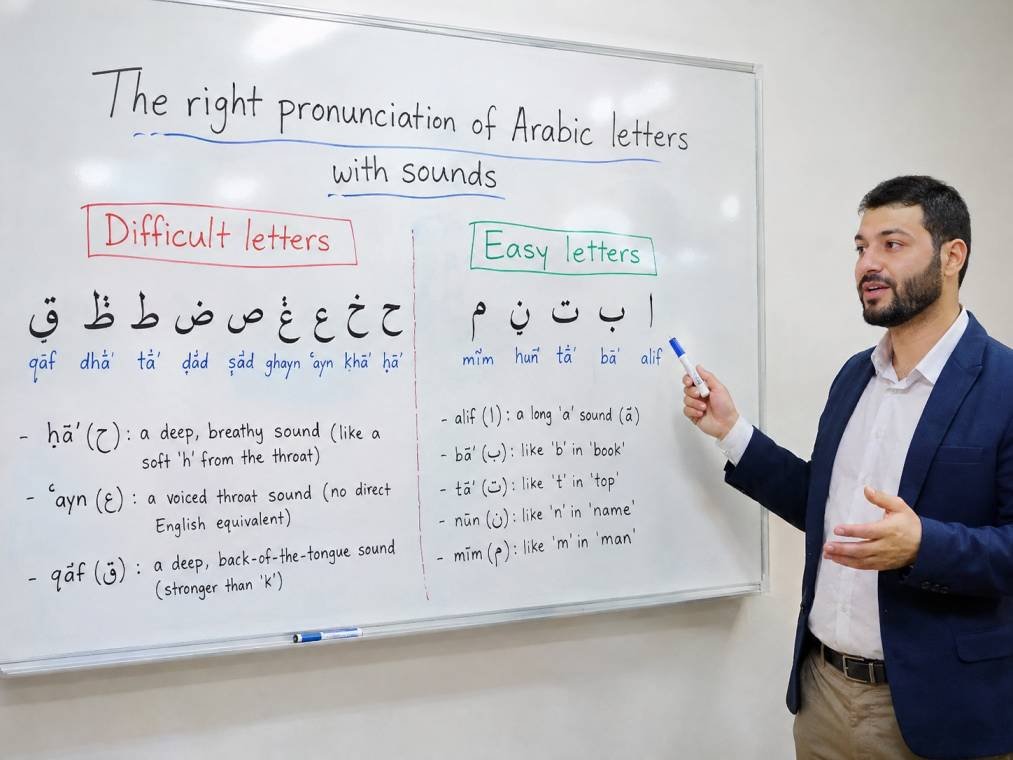
The good news is that you can start pronouncing Arabic letters at home. You need a clear example to listen to, a few minutes to practice, and a way to notice your mistakes. This guide gives you two teacher-video lessons (coming soon), practical tips for tricky sounds, and a seven-day challenge covering 10 letters.
If you are still learning to recognize the letters and their shapes, begin with our guide on how to learn the Arabic alphabet step by step. Here, we will focus on what happens after you see a letter: how to make its sound.
Watch and Repeat: How to Pronounce All 28 Arabic Letters
First, listen before you try to copy the sound. Watch the teacher pronounce a letter, pause, and repeat it aloud. Do not rush through all 28 letters in one sitting; revisit the sounds you find difficult.
A small but important detail: a letter’s name and its sound inside a word are not always the same thing. For example, the letter ب is named bāʾ, but when you read بَ, you say a short “ba” sound. Listening for this difference will help you later when you begin reading words.
- Letter name
- bāʾ
- Sound you read in بَ
- a short “ba”
You do not need to memorize every letter shape in this article. For the full sequence of shapes, vowel marks, and early reading skills, use our Arabic alphabet learning guide linked above.
How to Practice Arabic Pronunciation at Home
Here is a five-minute routine you can use with any letter. You can do it at your desk, in the kitchen, or while helping your child after school.
-
Listen twice before speaking
Play the letter sound two times. Pay attention to whether it is light or heavy and where the teacher seems to produce it: at the lips, with the tongue, or farther back in the mouth or throat.
-
Look at the teacher’s mouth
For visible sounds such as ب and ف, watch the lips and teeth. For sounds made deeper in the mouth or throat, use the teacher’s explanation rather than guessing from the video alone.
-
Repeat slowly, then normally
Say the sound three to five times with a short vowel, such as بَ، بِ، بُ. First aim for the correct sound; speed can come later. Do not squeeze your throat or force a sound that feels painful.
-
Record and compare
Make a short recording on your phone. Play the teacher’s version, then yours. Does the consonant sound the same? Is your vowel too long? Is one sound turning into another? Choose one thing to improve on the next attempt.
The Most Difficult Arabic Letters to Pronounce
Arabic has several sounds that do not have a direct equivalent in everyday English. They are not impossible to learn, but written English approximations can be misleading. The demonstrations below should be your main reference, with the descriptions acting as reminders.
ح and ه: Two sounds that should not become one
Both may look like “h” in an English pronunciation guide, but they are different. ه is a lighter breathy sound. ح involves a constriction farther back in the throat. Try هَ, then listen to the teacher demonstrate حَ. Keep the airflow controlled; pushing harder is not the goal.
خ and غ: Sounds made toward the back of the mouth
For خ, the back of your tongue approaches the soft palate area and produces friction without voicing. غ is produced farther back with a voiced, friction-like quality. Practice خَ and غَ as separate sounds. A familiar-sounding English spelling is not a substitute for hearing them.
ع and ء: Do not turn ʿayn into a vowel
The letter ع is especially unfamiliar to many English speakers. It uses a voiced narrowing in the throat. ء (hamzah), by contrast, is a brief closure and release at the vocal folds. Listen to عَ and أَ in the teacher’s demonstration. If you cannot hear or produce the difference yet, that is a useful place to ask for feedback.
ق and ك: The place of articulation matters
ك is made farther forward than ق. For the standard Arabic pronunciation of ق, the back of the tongue contacts the area around the uvula. The two letters should not sound identical. Compare قَ with كَ using teacher audio.
ص، ض، ط، ظ: Why “heavy” letters sound different
These emphatic consonants involve a backed or constricted tongue position that changes the quality of the sound and may affect a nearby vowel. Compare سَ / صَ, دَ / ضَ, تَ / طَ, and ذَ / ظَ. Do not simply say the ordinary letter more loudly. Sound quality, not volume, is the difference.
A teacher can help you correct these sounds more reliably than an English spelling guide. If a letter still sounds wrong after several attempts, save it for focused feedback rather than repeating an incorrect version dozens of times.
Common Arabic Pronunciation Mistakes Non-Arabic Speakers Make
Mistake 1: Saying the letter name instead of the sound
Knowing that ب is called bāʾ is useful, but reading بَ requires the short sound “ba.” When you practice reading, use the sound shown by the letter and its vowel mark, not the full alphabet name.
Mistake 2: Replacing an unfamiliar sound with an English one
A beginner may say ه instead of ح, ك instead of ق, or a plain س instead of ص. These substitutions can make different Arabic letters sound alike. Listen to each pair side by side and imitate only one difference at a time.
Mistake 3: Adding an extra vowel
When a consonant ends with sukūn (ـْ), do not automatically attach an extra “a” or “uh.” For example, مِنْ ends with نْ. Adding an unnecessary vowel changes what you are reading. This skill becomes more important when you start joining letters into words.
Mistake 4: Holding a short vowel for too long
In Arabic, vowel length matters. بَ has a short vowel, while بَا has a long ā sound. Listen to both and practice keeping their duration different. You can learn the full vowel-mark system in our alphabet guide.
Mistake 5: Practicing only by looking at transliteration
English spellings such as “kh” or “gh” are convenient memory aids, but they cannot capture every Arabic sound precisely. Keep the Arabic letter on screen, listen to the native-speaker audio, and gradually rely less on English spellings.
A 7-Day Arabic Pronunciation Challenge: Practice 10 Letters
You do not need to master all 28 letters this week. Start with 10 carefully chosen sounds: ب، م، ف، ت، د، س، ز، ح، خ، ع. The first seven build familiarity; the final three introduce more challenging throat sounds. Set aside about 10 minutes a day. The aim is better recognition and more accurate attempts, not perfect pronunciation in seven days.
0 of 7 days completed
Tick each day as you finish it.
-
Day 1ب and م: Start with your lips
Watch how the lips come together for ب and م. Play the audio, say بَ and مَ five times each, then record a short alternating sequence. Can you keep the two sounds distinct?
-
Day 2ف and ت: Notice your teeth and tongue
Practice فَ and تَ. For ف, the lower lip approaches the upper teeth. For ت, the tongue briefly touches the area just behind the upper teeth. Repeat each sound slowly, then switch between them.
-
Day 3د and س: Try a stop and a flowing sound
Practice دَ and سَ. Notice that د begins with a brief blockage, while س lets air flow through a narrow groove. Record three repetitions of each and compare them with the teacher.
-
Day 4ز: Add voicing
Say سَ, then زَ. Your tongue position is similar, but your voice is active for ز. Put a hand gently on your throat to notice the vibration. Finish with five clear repetitions of زَ.
-
Day 5ح and خ: Slow down for throat and back-of-mouth sounds
Replay the difficult-letters video for ح and خ. Practice حَ and خَ in short sets. Try to imitate the location and quality of each sound without forcing your throat. If either sound feels uncomfortable, stop and seek guidance.
-
Day 6ع: Practice one unfamiliar sound
Focus only on عَ today. Listen carefully, watch the teacher’s explanation, and make two short recordings with a break between them. Compare your attempt with the teacher, but do not expect it to feel natural immediately.
-
Day 7Review and record all 10 letters
Play the 10 letters in a random order, identify each one, then pronounce it with fatḥah (ـَ). Record yourself reading بَ، مَ، فَ، تَ، دَ، سَ، زَ، حَ، خَ، عَ. Mark the three sounds you would most like feedback on.
Your daily routine: 2 minutes listening, 4 minutes repeating, 2 minutes recording, and 2 minutes comparing. If you missed a day, simply continue; the challenge is a practice guide, not an exam.
7-Day Arabic Pronunciation Challenge
From “Pronouncing Arabic Letters at Home”, quranhomehub.com
Each day, about 10 minutes: 2 min listening, 4 min repeating, 2 min recording, 2 min comparing.
| Day | Letters | Focus | Done |
|---|---|---|---|
| 1 | بَ مَ | Start with your lips | |
| 2 | فَ تَ | Notice your teeth and tongue | |
| 3 | دَ سَ | Try a stop and a flowing sound | |
| 4 | زَ | Add voicing | |
| 5 | حَ خَ | Slow down for throat and back-of-mouth sounds | |
| 6 | عَ | Practice one unfamiliar sound | |
| 7 | بَ مَ فَ تَ دَ سَ زَ حَ خَ عَ | Review and record all 10 letters |
Three sounds I would like feedback on:
Missed a day? Simply continue. The challenge is a practice guide, not an exam.
How Can You Tell If You Are Pronouncing Arabic Correctly?
A recording helps you notice differences, but it does not always show why a sound is incorrect. Check three things:
- Can you recognize the target sound when you hear it?
- Can you keep it different from a similar letter?
- Can you pronounce it accurately with more than one short vowel?
Ask a qualified Arabic teacher to listen if you are uncertain about ح، ع، ق or the emphatic letters. Good feedback is specific: the teacher should tell you what your tongue or throat is doing, demonstrate the correct sound, and let you try again. That is more useful than hearing only “wrong” or “try again.”
Helping a Child or Finding Time as an Adult
With children
With children, turn repetition into a short game. Play one sound, hide the letter, then ask your child to choose it from two cards. Celebrate careful listening, not just speed. Five minutes of calm practice are enough for one session.
As a busy adult
If you are an adult with a crowded schedule, practice one difficult sound while your coffee is brewing or between daily tasks. Our separate article on learning to read Arabic as an adult explores how to make Arabic study fit real work and family routines.
Frequently Asked Questions About Arabic Letter Pronunciation
Can I learn to pronounce Arabic letters at home without a teacher?
You can begin at home using clear native-speaker audio and recording exercises. A teacher becomes especially valuable when you cannot hear the difference between two sounds or need correction of tongue and throat placement.
Which Arabic letters are usually hardest for English speakers?
Many learners need extra practice with ح، خ، ع، غ، ق and the emphatic letters ص، ض، ط، ظ. Difficulty varies with your first language and previous exposure to Arabic.
How long does it take to pronounce Arabic letters correctly?
There is no universal timeline. Familiar sounds may come quickly, while unfamiliar ones take repeated practice and feedback. A seven-day challenge is a starting routine, not a promise that every sound will be mastered.
Do I need to know the Arabic alphabet before practicing pronunciation?
No. You can listen and imitate from the first day. Recognizing the letter shapes alongside the sounds will make your practice more useful when you begin reading.
Ready to Move from Letter Sounds to Reading Arabic?
Learning Arabic pronunciation at home is a meaningful first step. But eventually you will want to connect the sounds, read complete words, and understand how the vowel marks work in real Arabic text and in learning how to read the Quran.
That is what our Arabic Reading Foundation course is designed to help you work toward. At Quran Home, learners practice with a teacher in live one-to-one classes, receive correction, and build their reading skills step by step.
See how guided lessons can help you turn the sounds you have practiced into real reading ability.
Pingback: How to Learn Arabic Alphabet Step by Step - Practical Guide
Pingback: Arabic Alphabet Chart PDF – Free Download - quranhomehub.com